

Ever wondered why your digital creations might look off or not as polished as you want? Getting high-quality results can be tough with complex software. You’re not alone in this fight, as many creators struggle with similar issues.
Learning to exclude certain elements can help you get rid of common visual problems. By improving your workflow, you can make sure your final work is top-notch. This guide will show you how to use these tools to boost your creative projects.
Consistency is the key to better results from your AI models. We’ll look at ways to control your images and get the exact look you want. Let’s explore the methods that will change your artistic process.
Key Takeaways
- Learn how to identify and remove unwanted visual artifacts.
- Discover the best practices for refining your generation workflow.
- Understand how to achieve higher fidelity in your creative projects.
- Master the art of excluding specific elements for cleaner results.
- Improve your overall output quality with proven technical strategies.
Understanding the Role of Negative Prompts AI Porn
Negative prompts are like the guardrails for your creative journey in AI art. They help steer the model away from common mistakes and unwanted styles. By using negative prompts ai porn, you guide the algorithm to avoid errors.
How Negative Prompts Influence Image Generation
Imagine navigating a dense forest. Your positive prompt is the destination. But, the AI might stray into unwanted territory like distorted shapes or blurry textures. Negative prompts act as a digital compass, keeping the model on course.
By adding specific terms to the negative field, you tell the software what to avoid. This reduces the chance of unwanted artifacts in your final image.
“The quality of your AI output is directly proportional to your ability to define what you do not want to see,” notes a leading expert in generative media.
The Difference Between Positive and Negative Prompting
It’s crucial to understand the difference between positive and negative prompts for professional results. Positive prompts define the core subject, lighting, and composition. Negative prompts, on the other hand, act as a filter to exclude unwanted traits.
| Feature | Positive Prompting | Negative Prompting |
|---|---|---|
| Primary Goal | Define the subject | Remove artifacts |
| Function | Inclusion | Exclusion |
| Impact | Sets the scene | Refines the quality |
| Usage | Required for every image | Essential for polish |
By balancing these two inputs, you have complete control over your creative output. Mastering negative prompts ai porn lets you work faster and produce cleaner images every time.
Setting Up Your CreatePorn AI Environment
Your success in creating high-quality visuals starts with your digital setup. A well-organized workspace boosts your creativity. It helps you avoid technical problems and focus on your art.
Configuring Global Negative Prompt Settings
Global settings are your first line of defense against unwanted visuals. By using negative prompts ai porn, you tell the model what to avoid. This keeps your images clean and professional.
Adding standard terms to your global settings helps prevent common problems. These settings ensure your output stays consistent, no matter the subject. Consistency is the key to a reliable workflow that saves time.
Managing Model-Specific Artifacts
Different models have unique quirks that need special adjustments. You can use LoRA modules to guide the AI’s understanding of your goals. This, along with targeted negative prompts ai porn, helps you control the AI’s output.
Testing how your model reacts to specific constraints is crucial. Some models might struggle with lighting, while others might smooth skin too much. Adjusting your negative inputs based on the model’s performance gives you full control over the final image.
| Setting Type | Primary Function | Impact Level |
|---|---|---|
| Global Defaults | General quality control | High |
| LoRA Modules | Anatomy and style guidance | Medium |
| Model-Specific | Fixing unique glitches | High |
| Prompt Weighting | Fine-tuning intensity | Medium |
Managing these variables ensures your negative prompts ai porn strategy works well. Keep a log of the best settings for your favorite models. This will make future projects easier.
Common Artifacts and How to Identify Them
Visual artifacts are common in AI art. Knowing how to spot them is key to a cleaner image. AI programs sometimes struggle with complex human forms or environmental physics.
Learning to identify these errors early helps. You can then use the right negative prompts to fix ai issues before they ruin your project.
Anatomy of a Distorted Image
Human form errors are common. You might see extra limbs, fused fingers, or disjointed joints. These glitches happen because the model doesn’t understand skeletal structure.
Spotting these distortions means your prompt needs more specific constraints. By adding targeted negative descriptors, you can fix ai issues. This ensures your characters look natural and believable.
Recognizing Texture and Lighting Glitches
Watch for texture and lighting issues too. Sometimes, AI makes skin look like plastic or wax. Other times, lighting might be flat or shadows don’t match the light source.
These problems can ruin your artwork’s depth and immersion. To fix ai issues with lighting, observe how shadows fall. Once you spot these issues, refine your prompts to keep textures and light balance realistic.
Essential Negative Prompt Recipes for Anatomy
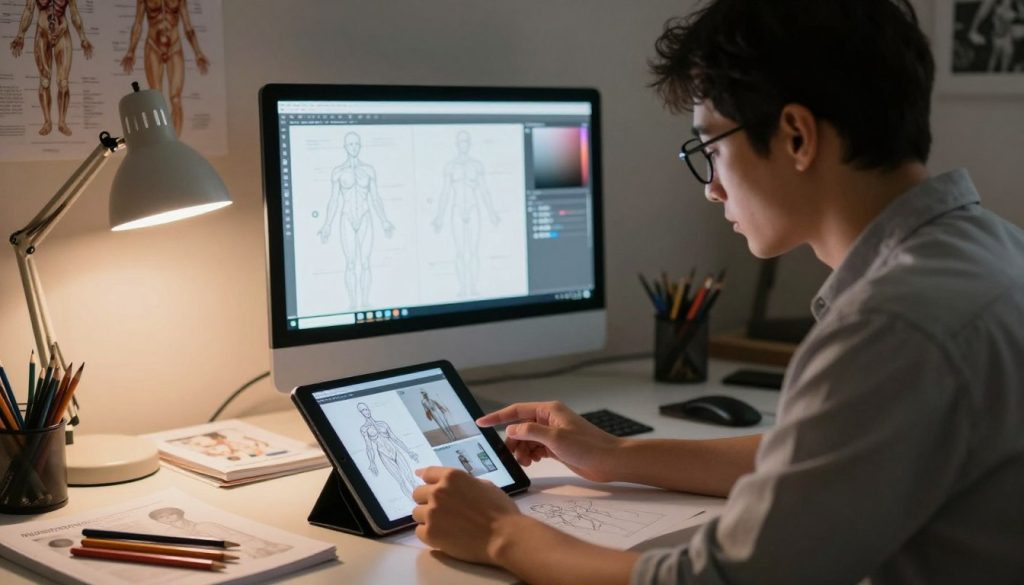
Getting realistic human shapes is hard for many AI models. When you see body errors, you need a way to fix ai issues fast. Using special negative prompts helps the model create more accurate body shapes.
Fixing Extra Limbs and Digit Errors
AI often makes extra fingers or joined limbs. To effectively fix these, use negative prompts like “extra fingers, mutated hands, fused limbs, missing digits, and malformed limbs.” These words help the model focus on real human body shapes.
For limb placement issues, add “extra legs, extra arms, and disjointed anatomy” to your prompts. This keeps the model’s creations structurally sound. Regular use of these prompts can solve ai problems with body placement.
Correcting Facial Symmetry and Eye Alignment
Facial features can be off, causing uneven looks or crossed eyes. Use negative prompts like “asymmetric eyes, distorted pupils, uneven facial features, and crossed eyes” to fix this. These prompts help the model create more balanced and natural faces.
For top-notch portraits, include “deformed iris, squinting, and misaligned eyes” in your prompts. This ensures the focus is on the character’s expression, not technical errors. These recipes are key to fixing ai issues in portrait making.
| Anatomical Area | Primary Negative Prompt | Expected Result |
|---|---|---|
| Hands and Fingers | Extra fingers, fused digits | Correct digit count |
| Facial Features | Asymmetric eyes, distorted pupils | Improved symmetry |
| Body Structure | Extra limbs, malformed joints | Natural proportions |
| General Quality | Fix ai issues, low quality | Refined output |
Refining Skin Texture and Body Details
Refining your images is all about finding the right balance. You want smooth surfaces but also realistic skin details. AI models can sometimes make your work look too perfect, like plastic. To avoid this, use specific negative prompts to keep the skin looking natural.
Removing Unnatural Skin Smoothing
Many models tend to over-smooth the skin, losing pores and natural texture. To fix this, add terms like “smooth skin,” “plastic texture,” or “airbrushed” to your negative prompts. This helps the model keep the natural skin texture and details that make a character look real.
If the skin still looks too perfect, try reducing the beauty or smoothness prompts. This lets the model show more realistic skin tones and imperfections. It’s a crucial step in your createporn polish process.
Addressing Unwanted Blemishes and Artifacts
At times, the model might create unwanted blemishes or skin discolorations. In these cases, inpainting is your best tool for fixing these issues. You can mask the area and use a focused prompt to make the skin match the rest of the body.
Outpainting can also be useful for extending the skin surface. This helps fix awkward cropping or edge issues. Using these methods with your negative prompts ensures your work looks polished. Below is a table showing how to tackle common skin problems.
| Issue Type | Negative Prompt Strategy | Correction Method |
|---|---|---|
| Plastic Skin | “smooth skin, airbrushed” | Reduce model weight |
| Skin Artifacts | “glitch, distorted, blotchy” | Inpainting |
| Unnatural Glow | “overexposed, shiny skin” | Adjust lighting prompts |
| Blurry Details | “low resolution, blurry” | Upscaling/Inpainting |
Mastering Negative NSFW Prompts for Composition
Even the most detailed character models can fail if the background looks messy. When creating complex scenes, AI models often struggle to balance the subject with the background. Using negative nsfw prompts helps remove unwanted visual noise. This forces the model to focus on a clean, professional layout.
Eliminating Cluttered Backgrounds
AI models often fill empty space with unnecessary objects, making scenes feel claustrophobic or chaotic. If your renders have too much furniture or random artifacts, add terms like “cluttered,” “messy,” or “overcrowded” to your negative list. This helps the AI focus on the subject, avoiding distracting elements.
Using negative nsfw prompts can also prevent unwanted architectural features. If the AI adds doors, windows, or pillars where they shouldn’t be, exclude them. This makes your final output look more polished.
Fixing Perspective and Depth Issues
Perspective errors can make walls appear warped or floors impossible. When the AI fails to keep a consistent vanishing point, scenes can look tilted or flat. Include terms like “distorted perspective,” “warped architecture,” or “flat depth” to guide the model toward realism.
Keeping proper scale is key for quality results. If your subject seems too big or small, negative nsfw prompts can help. By setting strict spatial constraints, your character stays the main focus without being overwhelmed by a bad background.
Advanced Techniques to Fix AI Issues
To get top-notch results, you need to control specific negative instructions well. When usual methods don’t work, you must use more detailed methods. With advanced strategies, you can make sure your final product looks great and handles negative nsfw prompts well.
Using Weighting to Strengthen Negative Prompts
Prompt weighting lets you decide how much a term affects the AI’s work. For example, (term:1.5) tells the AI to avoid certain traits like distorted fingers. This surgical precision is key when dealing with hard-to-remove artifacts.
“The true power of generative AI lies not in the prompt itself, but in the nuanced control the user exerts over the model’s boundaries.”
Higher weights make the AI more careful about those specific prompts. But, don’t overdo it, as it can harm the image. Start with small changes and see how the image changes.
Combining Negative Prompts for Complex Scenes
For complex scenes, you need a detailed plan. Mix different negative prompts for body, lighting, and background. A bounding box helps apply these rules to specific parts of the image.
The table below shows how different weights affect your negative prompts during rendering:
| Weight Level | Impact Intensity | Best Use Case |
|---|---|---|
| 0.5 – 0.8 | Subtle | Minor texture smoothing |
| 1.0 – 1.2 | Standard | General anatomy correction |
| 1.3 – 1.5 | Aggressive | Removing persistent artifacts |
| 1.6+ | Extreme | Forcing strict structural adherence |
By layering these instructions, you build a robust framework for the AI. It helps the AI create a cleaner, more professional image. Remember, the goal is to keep the AI creative while following your rules closely.
Optimizing CreatePorn Polish Through Iteration
Iteration is key to making high-quality images. It helps turn a rough draft into a masterpiece. By seeing your work as a series of experiments, you can get rid of unwanted parts. This focus on detail makes your createporn polish stand out.
The Process of Prompt Refinement
Improving your prompts is an ongoing process. Start by making small batches of images. This lets you see how your prompts work with the model.
If you spot errors, tweak your prompts a bit before making more images. Keep track of what works and what doesn’t. This systematic approach helps you create better instructions over time. Small changes add up to big improvements in your createporn polish.
“Quality is never an accident; it is always the result of high intention, sincere effort, intelligent direction and skillful execution.”
Testing and Comparing Results
Looking at different versions side-by-side helps you find the best prompts. Use a grid to compare multiple images at once. This makes it easier to see small differences in lighting and details.
Save good prompts for later use. If a prompt doesn’t work, try something new. Consistent testing ensures your images always meet your standards.
Troubleshooting Persistent Generation Errors
Even the best negative prompts can’t always fix ai issues if the main settings are off. When you see the same visual problems over and over, it’s clear your negative prompt is just part of the problem. Sometimes, you need to change how you approach making images.
When to Adjust Your Positive Prompt Instead
If your model doesn’t get what you mean, it might add things that don’t make sense. Adding more details to your positive prompt can help more than negative tags. Clearer instructions help the model understand what you want, which means it needs less negative guidance.
Make your positive prompt simpler if it has too many instructions. Too many details can confuse the model, making it hard to fix ai issues with negative prompts. Simplifying your positive prompt gives the model a solid base to work from.
Handling Model Overfitting
Model overfitting happens when a model is trained too much on a small dataset. This makes it produce the same, often wrong, images no matter what. If you see the same problems in every image, your model is likely overfitting.
Negative prompts don’t work well when a model is stuck in a pattern. To fix ai issues from overfitting, try lowering the guidance scale or using a different model. Trying different checkpoints is usually the best way to get around these problems.
Best Practices for Consistent Quality
Creating a reliable collection of negative prompts is key to keeping your output quality high. Treating your prompt management like a professional asset keeps your createporn polish top-notch on every project.
Consistency isn’t just about the model you use. It’s also about the precision of your instructions. By improving your approach, you cut down on errors and boost the visual impact of your content.
Building Your Personal Negative Prompt Library
Having a personal library of effective negative prompts saves you a lot of time in future projects. Organize your prompts by the specific issues they address, like limb distortion or skin texture.
Organization is key for long-term success. Use a simple text file or a dedicated spreadsheet to track which negative strings work best with specific models. This way, you can quickly find proven solutions instead of starting from scratch every time.
Sharing and Adapting Community Recipes
The AI art community is a great resource for new techniques. Prompt sharing platforms let users work together on and refine prompts for specific images. This helps everyone achieve better createporn polish.
Don’t be afraid to try out community-shared recipes, but always tweak them to fit your needs. Experimentation is crucial because a prompt that works for one person might need slight changes for you.
By documenting what works and learning from others, you build a strong toolkit that gets better with each generation. This cycle of collaboration ensures your skills keep growing with the technology.
Workflow Integration for Professional Results
To grow your creative work, you need to move from manual tweaks to automated systems. If you aim to keep quality high while making more content daily, you must link your negative nsfw prompts to a clear process. This way, every piece starts with a solid foundation, no matter the model or topic.
Automating Negative Prompt Injection
Professionals often automate tasks to save time. By using scripts or preset tools, you can add your negative nsfw prompts to every new project instantly. This method cuts down on mistakes and keeps your quality standards consistent.
Advanced users use APIs to link these prompts to their generation requests. This automated injection lets you focus on the creative aspects, not the technical details. With your prompts set in your workflow, you save a lot of time at the start of each project.
Balancing Speed and Quality in Generation
Creators often struggle to balance quick prototyping with detailed output. While speed is important, skipping quality checks can waste time and resources. Using the right negative nsfw prompts helps filter out low-quality images, ensuring only the best make it to the final stage.
Here are some tips to improve your workflow for both speed and quality:
| Workflow Strategy | Speed Impact | Quality Control |
|---|---|---|
| Manual Prompting | Low | High |
| Automated Injection | High | High |
| Batch Processing | Very High | Medium |
| Preset Library | Medium | Very High |
Conclusion
Learning to use negative prompts is a game-changer. It makes your AI-generated content look like it was made by a pro. Now, you can fine-tune your work in CreatePorn AI with more control.
By focusing on anatomy, composition, and texture, you can beat the limits of AI models. Your skill in these areas makes your work stand out from the usual AI output.
Keep trying out new recipes to explore your creative limits. Building a collection of great prompts helps keep your future projects looking amazing.
Don’t be shy to share your findings with others. It helps them improve their work too. The more you practice, the closer you’ll get to your artistic vision.
FAQ
What is the primary function of negative prompts in AI image generation?
Negative prompts act as a filter for AI. They tell the AI what not to include in your image. This helps fix issues like bad textures or wrong styles.
How do negative prompts differ from positive prompts in your workflow?
Positive prompts are like instructions. Negative prompts are like rules. Together, they help create a polished image.
Why should you use negative nsfw prompts for composition and background control?
Negative prompts help remove clutter from complex scenes. They keep your subject clear and focused.
What are the most effective recipes for fixing extra limbs and finger errors?
To fix limb errors, use terms like “extra fingers” in your negative prompts. Weighting these terms helps the AI avoid these mistakes.
How can you prevent skin from looking like plastic in your renders?
Avoid terms like “plastic skin” in your prompts. This keeps your skin looking natural. Use tools like Adobe Photoshop for extra details.
What is prompt weighting and how does it help with complex scenes?
Prompt weighting lets you control the AI’s focus. It’s key for avoiding mistakes in complex scenes.
When should you adjust your positive prompt instead of adding more negative prompts?
If your model repeats the same face, simplify your positive prompt. This gives the AI more freedom.
How do you build a personal library of effective negative prompts?
Save metadata from your best images. This helps you find the best prompts for your models. A library makes your workflow faster.
Can you automate the use of negative prompts for faster production?
Yes, save “Styles” or “Presets” with your favorite prompts. This speeds up your production and keeps your work consistent.
Where can you find community-shared recipes to fix common AI glitches?
Look on Reddit and Discord for AI art communities. They share universal negative prompts to fix common issues.